Scientists have discovered at least three new planets in our galaxy that could have allowed life to evolve.
The Earth-sized worlds lie in the "Goldilocks zone" of their sun, where temperatures are not too hot or cold, and are thought to be capable of having oceans of water.
They are in a group of at least seven planets orbiting a dwarf star called Trappist-1, in a newly discovered solar system 39 light years from us. A light year is the distance light travels in a year.
Researchers believe no other known star system contains such a large number of Earth-sized and probably rocky planets.
Trappist-1 lies in the Aquarius constellation and has just under a tenth of the mass of our Sun.
The research, led by NASA and its orbiting Spitzer telescope, was supported by, among others, a robotic telescope operated by Liverpool John Moores University (JMU).
The telescope, which is located in the Canary Islands off the west coast of Africa, helped detect the planets as they passed in front of their star.
Project co-leader and astronomer Dr Chris Copperwheat said: "The discovery of multiple rocky planets with surface temperatures which allow for liquid water make this amazing system an exciting future target in the search for life."
The quest to discover definitively whether life could have been sustained elsewhere in the universe has been intensifying since the first planet outside our solar system was found in 1992.
Since then, astronomers have recorded more than 3,500 worlds in 2,675 star systems.
Just last week, NASA announced it had discovered carbon-based organic material , similar to what may have been the building blocks for life on Earth, on Ceres, a dwarf planet located between Mars and Jupiter.
In November, the US space agency's New Horizons spacecraft found evidence that Pluto may have a huge ocean hidden under its frozen surface.
The vast site, containing as much water as all of Earth's seas, could also potentially be a habitat for life.
Wednesday, February 22, 2017
Scientists discover three new planets where life may have evolved

Google and Bing cracks down on piracy
Illegally streamed live football matches, pirated music and other creative material will be more difficult to search for under a plan to crack down on piracy websites.
Google and Bing have signed up to a voluntary code of practice aimed at protecting users' safety and preventing them from visiting disreputable content providers.
Demotion of illegal sites will be accelerated by the code, which is the first of its kind in the UK.
Anyone who searches for content such as music videos, digital books and football coverage will more likely be taken to bona fide providers rather than pirate sites where a user's security may be at risk.
Eddy Leviten, director general at the Alliance for Intellectual Property, said: "Sometimes people will search for something and they will end up unwittingly being taken to a pirated piece of content.
"What we want to ensure is that the results at the top of the search engines are the genuine ones.
"It is about protecting people who use the internet, but also protecting the creators of that material too."
The Intellectual Property Office (IPO) led the discussions to create the code, with the assistance of the Department for Culture, Media and Sport (DCMS).
Ofcom has examined in detail the way that search results are presented to internet users, and explored possible techniques and metrics that make it easier for UK consumers avoid illegitimate content.
The code, expected to be rolled out in the summer, will run in parallel with existing anti-piracy measures aimed at reducing online infringement.
These include court-ordered site blocking, work with brands to reduce advertising on illegal sites, and the Get it Right From A Genuine Site consumer education campaign, which encourages fans to value the creative process and directs them to legal sources of content.
Stan McCoy, of the Motion Picture Association in Europe, said: "Pirate websites are currently much too easy to find via search, so we appreciate the parties' willingness to try to improve that situation.
"We look forward to working on this initiative alongside many other approaches to fighting online piracy."
Geoff Taylor, chief executive of BPI, representative body for UK record labels, and the Brit Awards, said: "The code will not be a silver bullet fix, but it will mean that illegal sites are demoted more quickly from search results and that fans searching for music are more likely to find a fair site."
Comercial space flights from UK by 2020 possible
Space ports could be set up and satellites could blast off from regions across the UK under new proposals set to be unveiled this week.
The Spaceflight Bill would allow scientists to conduct experiments in zero gravity - paving the way for the development of vaccines and antibiotics, the Department for Transport (DfT) said.
Science minister Jo Johnson said the bill would "cement the UK's position as a world leader in this emerging market".
Under the proposals, the first commercial flight from a UK space port could lift off by 2020.
Mr Johnson said: "From the launch of Rosetta, the first spacecraft to orbit a comet, to Tim Peake's six months on the International Space Station, the UK's space sector has achieved phenomenal things in orbit and beyond.
"With this week's Spaceflight Bill launch, we will cement the UK's position as a world leader in this emerging market, giving us an opportunity to build on existing strengths in research and innovation."
Aviation minister Lord Ahmad said: "We have never launched a spaceflight before from this country.
"Our ambition is to allow for safe and competitive access to space from the UK, so we remain at the forefront of a new commercial space age."
Grants worth £10m would be made available to help develop commercial launch capability for spaceflight.
The commercial spaceflight market is worth an estimated £25bn over the next 20 years.
The bill will be unveiled in Parliament this week.
Your galaxy phones will soon unlock your windows 10 device
Good news for Galaxy phone owners who
use Windows 10 : Samsung plans to make its
Flow app compatible with any device that
runs Windows 10. This means that in
addition to being able to unlock your
Windows 10 computer with your Galaxy
phone's fingerprint sensor, you'll also be
able to seamlessly hand off tasks,
notifications and content to your Windows 10
PC.
Samsung has some great news for Windows
10 users.
Screenshot by Patrick Holland/CNET
As reported by SamMobile , Samsung
responded to comments on the Google Play
Store confirming future support of the Flow
app with any Windows 10 device (Samsung
or otherwise).
The Flow app, Samsung's answer to Apple's
Handoff, allows continuity between Samsung
Galaxy phones and the Windows-based
Galaxy TabPro S . The goal is to move
content (like Web articles) from a phone to
the TabPro S with minimal interaction. The
Flow app also lets you interact with your
phone notifications from a TabPro S. These
features will soon be available on any
Windows 10 device.
Samsung Flow adds continuity and
convenience to your Galaxy phone and
Galaxy TabPro S.
James Martin/CNET
Samsung didn't immediately respond to a
request for comment. But according to the
company's response on the Google Play
Store, the updated app will be available in
early April.
Why is the uk obsessed with rockets?
Phwoar, the power. Just imagine it: the pulsing, explosive power of a rocket launch. The sheer force. Tonnes of rigid metal, spewing fire, surging straight up, heading out into the final frontier. Very alpha.
Well, the Government wants some of that action. This week the Department for Transport published a draft Spaceflight Bill. It should allow spaceports to be built and satellites to be launched from British soil for the first time. All by 2020. Woof!
It's space-viagra for a flaccid, post-Brexit Britain. And it's the ultimate stimulant. Look at the euphoria that greeted Major Tim Peake's trip to the International Space Station.
Some 536 people (including Major Peake) have been to space, but his voyage, during which he watched the rugby and attended the BAFTAs, won wall-to-wall coverage. We liked it so much we're sending him back there for another go.
Why the extra-terrestrial jingoism? As part of the Government's bill, aviation minister Tariq Ahmad said: "We have never launched a spaceflight before from this country." You almost can hear the wistfulness in his voice.
Britain missed out on the space race - we were too poor, too grey, too small - and it's given us a complex. Bigger, more virile nations launched their rockets. So did France, even more humiliatingly. And now, a new generation of countries and private companies is making us feel inadequate all over again.
It shouldn't. Despite the lack of big, show-off launches, the UK has ended up with a thriving, modern space sector.
The performance anxiety is understandable; it's part of our history of decline. As the Second World War came to a close, the UK was just as keen as the US to get its hands on the Nazis' technological secrets. In particular, the V2 rocket, partly because it had terrorised London, but mainly because it held the key to the coming space age.
Allied soldiers and scientific advisers scouted ahead of the main advance, searching for documents and devices. But when they came across Mittelwerk - the underground V2 facility where thousands of slave labourers died building rockets - the Americans simply bullied the Brits and kept the V2s to themselves. Just 24 years later, they were on the moon, thanks to Wernher von Braun and his fellow Nazi scientists.
Meanwhile, our space programme was short-lived and based largely on the Isle of Wight, in Cowes. It culminated with the launch of a Blue Arrow rocket in Australia in 1971, carrying a satellite into space. The UK remains the only country to develop a satellite programme, then abandon it.
Despite that, though, the UK excels at space. We build advanced satellites in places like Stevenage and Surrey. Our scientific research opens up new fields. This was Tim Peake's contribution on the International Space Station: the science he did, not the fact he was British.
His voyage was possible because we're part of the European Space Agency, which landed a robotic spacecraft on a comet. One of the biggest satellite communications companies in the world, Inmarsat, is based on a roundabout in east London. All without the expense and bother of launching rockets ourselves.
Indeed, where the Isle of Wight failed, the Isle of Man succeeded. It focused not on rocket launches, but on space services - law, insurance, accounting. Not as sexy as a launch, but lucrative and much less risky. And the sort of thing the UK as a whole is very good at.
The Isle of Man did suffer some embarrassment, but only when it touted Manx space tourism and actual launches, with flights priced at £100m. A private company imported a 1980s Russian space station, then quietly shipped it off the island four years later.
There are better places to launch rockets than the UK: I have checked on a map and we're quite far away from the equator. (Launching satellites into polar orbits makes more geographic sense, but they aren't much use for communications satellites.) Nor do we need to launch rockets ourselves to make money from them.
Blasting off from spaceports is the status symbol of a bygone age. If we truly were a self-confident nation, we'd leave the willy-waving to others.
Tinder wants AI to set you up on a date
When I first met Sean Rad, back in 2013, Tinder
was a blossoming dating app. It was known
primarily for, how shall I put it, casual
relationships.
Back then he told me Tinder was “good for
humanity”, a line I instantly latched onto as being
faintly ridiculous, and wonderful for a headline.
But now when I think of how Tinder has
impacted my life, and those of several people
close to me, I start to see what he was getting
at.
Life-changing things have happened to millions
of people thanks to that simple swipe-yes-swipe-
no interface.
I know people who have married their Tinder
matches. I know many others who are in serious
relationships. And yes, I know many people who
have had casual hook-ups and one-night stands.
Yet why that last point is seen as a negative to
be joked about I’ll never know. People have been
doing that in bars for well over 100 years.
Anyway, Tinder is growing up. It’s now a serious
technology company tackling one of life’s most
important matters, and is by far the most
popular dating app worldwide.
After a lot of boardroom musical chairs , Mr Rad
is the chairman of both Tinder and Swipe
Ventures, the arm of the company designed to
buy other dating-related technologies.
One of which is artificial intelligence. And its
collision with dating might be the most intriguing
application of AI yet.
“I think this might sound crazy,” Mr Rad said on
Tuesday at tech conference Start-Up Grind.
"In five years time, Tinder might be so good, you
might be like “Hey [Apple voice assistant] Siri,
what’s happening tonight?’
“And Tinder might pop up and say 'There’s
someone down the street you might be attracted
to. She’s also attracted to you. She’s free
tomorrow night. We know you both like the same
band, and it’s playing - would you like us to buy
you tickets?’… and you have a match.
"It’s a little scary."
Also a little lazy, you might say. Part of the
dating process is surely assessing someone’s
tastes and idea of fun. If that’s taken out of the
equation, it’s a lot harder to understand a
person.
Still, even though it can be difficult to admit,
dating really is a numbers game, and right now
the data Tinder uses is primitive: age, location
and mutual friends - as well as a few mutual
interests as defined by what you “like” on
Facebook. Why not add a few parameters and
make it even more likely you will click?
Traffic light party
Anyone who has been a student will know about
“traffic light parties” (or stoplights if you’re an
American). A hideous concept in which you go
on a night out dressed in either red, amber or
green. Red means “in a relationship and happy”.
Green means “single and looking”. Amber means
you’re a bad human being.
The idea is that two “greens” can find each
other easily. Quite why anyone would go as a
“red” is anyone’s guess.
Now, this works (in theory) on university
campuses. But such a system would be bedlam
in the real world - particularly on St Patrick’s
Day, I'd imagine.
But you have to admit, a way of knowing
someone’s relationship status without having to
ask would be a very useful tool. Indeed, it’s what
made Facebook popular in its early days.
Mr Rad sees a time when Tinder could offer a
form of real-life traffic party through augmented
reality.
AR is the technology that overlays digital images
onto the real world as you walk around. So far
the only truly popular application of it has been
Pokemon Go, which, while bringing people
together, isn’t the relationship fast-track most
people are presumably looking for.
But what if you could use AR to meet potential
partners?
"That will definitely impact dating,” Mr Rad said,
noting Tinder is popular for so many people
because it allows us to show interest in a person
without the fear of rejection.
"You can imagine how, with augmented reality,
that experience could happen in the room, in real
time. The impact is profound as these devices
get closer to your senses, to your eyes, to your
experiences.”
That might make you deeply uncomfortable. I
don't blame you. As ever, it will be up to
technology companies - not just Tinder - to roll
out such ideas in way that doesn’t encroach on
privacy, or indeed, common decency and
manners. The key word here is, as always,
consent.
Tinder’s future lives and breathes on its ability to
remain the most popular app for getting people
together and into relationships. More recently,
rival services like Bumble have shown signs of
disrupting Tinder’s dominance. Bumble’s key
selling point is the fact women have to initiate
the conversations.
But there’s plenty of market to go round. Tinder
now has a far more global focus, Mr Rad said,
with approximately 600 million smartphone-toting
single people ready to find The One.
64GB Iphone could put an end to low storage iphones
Apple may dump its low-storage option on its
upcoming iPhone 8, which could start at the
64GB version, according to TrendForce.
It wouldn't be the first time. Apple ditched
the dreaded 16GB iPhone when it released
the iPhone 7, making 32GB the phone's
smallest storage option. Apple may continue
the trend by making 64GB the new smallest
capacity, and tossing out the 32GB option
altogether. The larger-capacity iPhone 8 is
said to storage 256GB of photos, video and
apps.
The move could play a part in the pricing of
the upcoming iPhone. A 256GB iPhone 7 will
already set you back $849/£799/AUD$1,379,
and the premium iPhone 8 is rumored to
cost over $1,000 with the introduction of
new technology like OLED displays . Limiting
the smallest size to 64GB instead of 32GB
could result in a higher price for the
cheapest iPhone 8 option, which could
dissuade some buyers.
While the 4.7-inch iPhone 7S and 5.5-inch
iPhone 7S Plus are believed to have a
maximum of 256GB storage, the report does
not offer their exact storage capacities.
What the report does say is that the iPhone
7S will be more economically priced to
compete against other smartphone brands.
That could mean less storage to keep costs
down.
All of the iPhone 8's rumored features
brought to life in a beautiful concept design
The TrendForce report also adds (or
supports) the following rumors:
Check out the full list of rumored iPhone 8
features here.
Apple did not respond to a request for
comment.
TAGS
Phones
Read 0 Comments
MORE FROM CNET
The 64GB iPhone 8
could put an end to low-
storage iPhones
A recent report suggests 64GB and
256GB storage capacities, and that's
it.
0 Handy Abovergleich
8
We may see three new iPhone models: a
4.7-inch, 5.5-inch, and a high end 5.8-inch
version
•
The 5.8-inch version could get an
AMOLED display, 2K resolution and no
curved display
•
The 5.8-inch version could lose its home
button and increase its body-to-screen
ratio, making it around the same size as
the 4.7-inch version
•
The 4.7-inch and 5.5-inch versions may
both have LCD displays
•
The 5.5-inch and 5.8-inch versions could
have 3GB of RAM, while the 4.7-inch
version may stick to 2GB of RAM
Facebook confusion over fake cancer babies U-turn
Facebook has apologised for repeatedly restoring
an account that posted stolen photos of children
falsely claiming they had cancer.
The social network twice disabled the account
following complaints, only to re-enable it hours
later.
"These posts are clearly distressing for the
families and this content has now been
removed," a spokeswoman said.
"We apologise for the delay in taking them
down."
The social network acted for a third time after
the matter was brought to its attention by the
BBC. It has not explained the actions of its
complaints team.
One internet expert said the behaviour had been
"bonkers" and called into question Facebook's
safety procedures.
Fake appeal
The BBC reported on Tuesday the case of a
child from Cambridgeshire whose photos had
been used alongside a fake plea for help.
"This little baby has cancer and he need money
for surgery," the accompanying post stated.
It added that Facebook would donate money for
every "like", comment or share of the message.
The picture was posted at the start of February.
More than one million people responded.
Security experts said such tactics were often
used by "like farming" scammers .
Perpetrators attempt to engage as many users
as possible so that they can later target them
with follow-up messages and/or sell on the
profile page and its associated contacts to
unscrupulous marketers.
The mother of the child - Sarah Allen from St
Neots, Cambridgeshire - said she had been upset
by the discovery.
"We had people messaging saying they had
heard Jasper has cancer," she told the BBC.
"He doesn't. These were pictures from when he
had chickenpox."
Facebook eventually deleted this post but - after
overturning Tuesday's short-lived account block -
left similar fake cancer posts featuring other
children live.
The BBC determined they included an photo of a
three-year-old girl from England, who was injured
in a road accident in 2015. The image belongs to
her parents.
"I need the photo to be removed," said the
mother of the girl - who asked not to be named -
when she was informed of its misuse.
"I am extremely upset about it."
Other images showed:
a teenage boy from Texas in a coma with
viral meningitis. His family had run a
separate crowdfunding campaign to help pay
for his treatment
a young girl from Texas who has progeria, a
genetic disorder that causes premature
ageing. Her mother had blogged about her
life
a baby girl from Pennsylvania, who needed
an operation for omphalocele, a birth defect
of her abdomen. Her parents had shared
photos online of her surgery
a baby from Florida, who died after being
born with a defect of the diaphragm. The
image had been featured in the local press
In addition, the account featured several photos
of dead young children in coffins, claiming users
would have "76 year of bad luck" if they scrolled
past without liking or sharing the posts.
Facebook's community standards say it does not
allow posts featuring images that infringe other
people's copyright.
The company does not require each rights holder
to make a claim before acting.
'Bare minimum'
Facebook first disabled the account on 10
January after Mrs Allen had sent several
messages to its complaints team, only for it to
be made live again the next day.
The social network took the account offline
again on Tuesday afternoon, but it was active
again about five hours later.
The BBC questioned the decision early this
morning. But it was not until about 15:00 GMT
that the account was taken offline for a third
time.
Cybersecurity expert Prof Alan Woodward said
Facebook did not appear to have scrutinised the
case closely enough despite the publicity it had
already generated.
"Clearly anybody should have the right to appeal
their account being taken down, but if it's
returned up that quickly it doesn't show much
due process has been taken in checking it out,"
said the University of Surrey lecturer.
"It's difficult not to conclude Facebook was
doing the bare minimum here."
Saturday, July 23, 2016
Apple iphone 6S
NETWORK
LAUNCH Announced 2015, September
Status Available. Released 2015, September
BODY Dimensions 138.3 x 67.1 x 7.1 mm (5.44 x 2.64 x 0.28 in)
Weight 143 g (5.04 oz)
SIM Nano-SIM
- Apple Pay (Visa, MasterCard, AMEX certified)
DISPLAY Type LED-backlit IPS LCD, capacitive touchscreen,
16M colors
Size 4.7 inches (~65.6% screen-to-body ratio)
Resolution 750 x 1334 pixels (~326 ppi pixel density)
Multitouch Yes
Protection Ion-strengthened glass, oleophobic coating
- 3D Touch display
- Display Zoom
PLATFORM OS iOS 9, upgradable to iOS 9.3.3, planned upgrade
to iOS 10
Chipset Apple A9
CPU Dual-core 1.84 GHz Twister
GPU PowerVR GT7600 (six-core graphics)
MEMORY Card slot No
Internal 16/64/128 GB, 2 GB RAM
CAMERA Primary 12 MP, f/2.2, 29mm, phase detection autofocus,
dual-LED (dual tone) flash, check quality
Features 1/3" sensor size, 1.22 µm pixel size, geo-tagging,
simultaneous 4K video and 8MP image recording,
touch focus, face/smile detection, HDR (photo/
panorama)
Video 2160p@30fps, 1080p@60fps,1080p@120fps,
720p@240fps, check quality
Secondary 5 MP, f/2.2, 31mm, 1080p@30fps, 720p@240fps,
face detection, HDR, panorama
SOUND Alert types Vibration, proprietary ringtones
Loudspeaker Yes
3.5mm jack Yes
- 16-bit/44.1kHz audio
- Active noise cancellation with dedicated mic
COMMS WLAN Wi-Fi 802.11 a/b/g/n/ac, dual-band, hotspot
Bluetooth v4.2, A2DP, LE
GPS Yes, with A-GPS, GLONASS
NFC Yes (Apple Pay only)
Radio No
USB v2.0, reversible connector
FEATURES Sensors Fingerprint, accelerometer, gyro, proximity,
compass, barometer
Messaging iMessage, SMS (threaded view), MMS, Email,
Push Email
Browser HTML5 (Safari)
Java No
- Siri natural language commands and dictation
- iCloud cloud service
- MP3/WAV/AAX+/AIFF/Apple Lossless player
- MP4/H.264 player
- Audio/video/photo editor
- Document editor
BATTERY Non-removable Li-Po 1715 mAh battery (6.9 Wh)
Stand-by Up to 240 h (3G)
Talk time Up to 14 h (3G)
Music play Up to 50 h
MISC Colors Space Gray, Silver, Gold, Rose Gold
SAR US 1.14 W/kg (head) 1.14 W/kg (body)
SAR EU 0.87 W/kg (head) 0.98 W/kg (body)
Price group 9/10
TESTS Performance Basemark OS II 2.0: 2195
Display Contrast ratio: 1481 (nominal), 3.783 (sunlight)
Camera Photo / Video
Loudspeaker Voice 66dB / Noise 64dB / Ring 65dB
Audio quality Noise -93.8dB / Crosstalk
Technology GSM / CDMA / HSPA / EVDO / LTE

Apple iphone 6S plus
NETWORK
LAUNCH Announced 2015, September
Status Available. Released 2015, September
BODY Dimensions 158.2 x 77.9 x 7.3 mm (6.23 x 3.07 x 0.29 in)
Weight 192 g (6.77 oz)
SIM Nano-SIM
- Apple Pay (Visa, MasterCard, AMEX certified)
DISPLAY Type LED-backlit IPS LCD, capacitive touchscreen,
16M colors
Size 5.5 inches (~67.7% screen-to-body ratio)
Resolution 1080 x 1920 pixels (~401 ppi pixel density)
Multitouch Yes
Protection Ion-strengthened glass, oleophobic coating
- 3D Touch display
- Display Zoom
PLATFORM OS iOS 9, upgradable to iOS 9.3.3, planned upgrade
to iOS 10
Chipset Apple A9
CPU Dual-core 1.84 GHz Twister
GPU PowerVR GT7600 (six-core graphics)
MEMORY Card slot No
Internal 16/64/128 GB, 2 GB RAM
CAMERA Primary 12 MP, f/2.2, 29mm, phase detection autofocus,
OIS, dual-LED (dual tone) flash, check quality
Features 1/3" sensor size, 1.22 µm pixel size, geo-tagging,
simultaneous 4K video and 8MP image recording,
touch focus, face/smile detection, HDR (photo/
panorama)
Video 2160p@30fps, 1080p@60fps, 1080p@120fps,
720p@240fps, check quality
Secondary 5 MP, f/2.2, 31mm, 1080p@30fps, 720p@240fps,
face detection, HDR, panorama
SOUND Alert types Vibration, proprietary ringtones
Loudspeaker Yes
3.5mm jack Yes
- 16-bit/44.1kHz audio
- Active noise cancellation with dedicated mic
COMMS WLAN Wi-Fi 802.11 a/b/g/n/ac, dual-band, hotspot
Bluetooth v4.2, A2DP, LE
GPS Yes, with A-GPS, GLONASS
NFC Yes (Apple Pay only)
Radio No
USB v2.0, reversible connector
FEATURES Sensors Fingerprint, accelerometer, gyro, proximity,
compass, barometer
Messaging iMessage, SMS (threaded view), MMS, Email,
Push Email
Browser HTML5 (Safari)
Java No
- Siri natural language commands and dictation
- iCloud cloud service
- MP3/WAV/AAX+/AIFF/Apple Lossless player
- MP4/H.264 player
- Audio/video/photo editor
- Document editor
BATTERY Non-removable Li-Po 2750 mAh battery (10.45
Wh)
Stand-by Up to 384 h (3G)
Talk time Up to 24 h (3G)
Music play Up to 80 h
MISC Colors Space Gray, Silver, Gold, Rose Gold
SAR US 1.12 W/kg (head) 1.14 W/kg (body)
SAR EU 0.93 W/kg (head) 0.98 W/kg (body)
Price group 9/10
TESTS Performance Basemark OS II 2.0: 2261
Display Contrast ratio: 1382:1 (nominal), 3.530 (sunlight)
Camera Photo / Video
Loudspeaker Voice 65dB / Noise 65dB / Ring 64dB
Audio quality Noise -93.4dB / Crosstalk -71.1dB
Technology GSM / CDMA / HSPA / EVDO / LTE

Apple iphone SE
NETWORK
LAUNCH Announced 2016, March
Status Available. Released 2016, March
BODY Dimensions 123.8 x 58.6 x 7.6 mm (4.87 x 2.31 x 0.30 in)
Weight 113 g (3.99 oz)
SIM Nano-SIM
- Apple Pay (Visa, MasterCard, AMEX certified)
DISPLAY Type LED-backlit IPS LCD, capacitive touchscreen,
16M colors
Size 4.0 inches (~60.8% screen-to-body ratio)
Resolution 640 x 1136 pixels (~326 ppi pixel density)
Multitouch Yes
PLATFORM OS iOS 9.3.2, upgradable to iOS 9.3.3, planned
upgrade to iOS 10
Chipset Apple A9
CPU Dual-core 1.84 GHz Twister
GPU PowerVR GT7600 (six-core graphics)
MEMORY Card slot No
Internal 16/64 GB, 2 GB RAM
CAMERA Primary 12 MP, f/2.2, 29mm, phase detection autofocus,
dual-LED (dual tone) flash, check quality
Features 1/3" sensor size, 1.22 µm pixel size, geo-tagging,
simultaneous 4K video and 8MP image recording,
touch focus, face/smile detection, HDR (photo/
panorama)
Video 2160p@30fps, 1080p@30/60fps, 1080p@120fps,
720p@240fps, check quality
Secondary 1.2 MP, f/2.4, 31mm, 720p@30fps, face
detection, HDR, FaceTime over Wi-Fi or Cellular
SOUND Alert types Vibration, proprietary ringtones
Loudspeaker Yes
3.5mm jack Yes
- 16-bit/44.1kHz audio
- Active noise cancellation with dedicated mic
COMMS WLAN Wi-Fi 802.11 a/b/g/n/ac, hotspot
Bluetooth v4.2, A2DP, LE
GPS Yes, with A-GPS, GLONASS
NFC Yes (Apple Pay only)
Radio No
USB v2.0, reversible connector
FEATURES Sensors Fingerprint, accelerometer, gyro, proximity,
compass
Messaging iMessage, SMS (threaded view), MMS, Email,
Push Email
Browser HTML5 (Safari)
Java No
- Siri natural language commands and dictation
- iCloud cloud service
- MP3/WAV/AAX+/AIFF/Apple Lossless player
- MP4/H.264 player
- Audio/video/photo editor
- Document editor
BATTERY Non-removable Li-Po 1624 mAh battery (6.21
Wh)
Stand-by Up to 240 h (2G) / Up to 240 h (3G)
Talk time Up to 14 h (3G)
Music play Up to 50 h
MISC Colors Space Gray, Silver, Gold, Rose Gold
SAR US 1.17 W/kg (head) 1.19 W/kg (body)
SAR EU 0.97 W/kg (head) 0.99 W/kg (body)
Price group 8/10
TESTS Performance Basemark OS II 2.0: 2163
Display Contrast ratio: 804:1 (nominal), 3.681 (sunlight)
Camera Photo / Video
Loudspeaker Voice 66dB / Noise 65dB / Ring 69dB
Audio quality Noise -93.0dB / Crosstalk -72.9dB
Technology GSM / CDMA / HSPA / EVDO / LTE.
Disclaimer: we can not guaranty that the information on this page is 100% correct

Friday, July 22, 2016
Tecno Y5
GENERAL DESIGN
Phablet Android 4.4 (KitKat)
143 x 71.7 x 8.9 mm. 150 grams.
DISPLAY FEATURES
5.0 inches, 480 x 854 pixels, 196 pixels per inch
IPS capacitive LCD touchscreen with 16,000,000 colors
CAMERA
Front: 5MP, up to 2592 x 1944-pixel pictures, HDR, autofocus, panorama,
Back: 2MP up to 1600 x 1200-pixel pictures Geo-tagging camera with LED flash
MEMORY DETAILS
8GB, 1GB RAM, 1.3GHz dual-core Cortex-A7 CPU, MediaTek MT6572 Chipset, Mali-400 GPU Yes, Up to 32GB
OTHER DEVICE DETAILS
2300mAh Li-Ion battery
2G (GSM 850 / 900 / 1800), 3G (HSDPA 2100) and No 4G
Dual Mini-SIM
Wi-Fi 802.11 b/g/n, Wi-Fi hotspot Yes, v3.0 Yes, microUSB v2.0
Accelerometer, Proximity No Java- MP3/WAV/ eAAC+/WMA player
– FM Radio – MP4/ H.264/H.263/WMV player – Image viewer and editor – Document viewer and editor – Preloaded applications – GTalk, WhatsApp, Facebook, YouTube, Google Talk, etc.

Wednesday, July 20, 2016
Infinix Hot 2
General Information
2G Network GSM 850 / 900 / 1800 / 1900
3G Network HSDPA 900 / 2100
4G Network No
SIM Dual mini SIM
Status: Announced August 2015
Body
Dimensions
Keyboard Touchscreen
Colors White, Black
Cover Plastic
Display
Type IPS, capacitive, touchscreen with
16,000,000 colors
Size 5.0 inches, 720 x 1280 pixels, 294
pixels per inch
Memory And OS
Card slot MicroSD, up to 32GB
Internal 16GB
OS Android 5.1.1 Lollipop
Processors
1.3GHz quad-core Cortex-A7 CPU,
MediaTek MT6582 chipset,
Mali-400MP2 GPU
RAM 1GB and 2GB versions
Audio
Alert types Vibration, MP3 ringtones
Loudspeaker Yes
Audio port 3.5mm jack
Connectivity
2G GPRS – up to 85.6 kbps; EDGE –
up to 236.8 kbps
3G Up to 21 mbps downlink; Up to
5.67 mbps uplink
4G No
WIFI Wi-Fi 802.11 b/g, Wi-Fi hotspot
Bluetooth Version 4.0
GPS A-GPS
NFC No
USB MicroUSB v2.0
Camera
Primary 8MP, up to 3264 x 2448-pixel
pictures camera with LED flash
Video 1080p@30fps
Secondary 2MP up to 1600 x 1200-pixel
pictures
Battery
Capacity 2200mAh Li-Ion battery
Stand-by
Talk time
Music play
Other Features
Sensors Accelerometer, Proximity
Messaging SMS, MMS, Email, Push Mail, IM
Browser HTML
Java No
Miscellaneous
– FM Radio
– MP4/H.264/H.263/WMV player
– Image viewer and editor
– Document viewer and editor
Price


Tecno camon C9
Specifications
NETWORK: GSM/ HSPA/ LTE
BODY: 153×76.4×10.35mm
DISPLAY: 5.5 inches, 1920 × 1080 pixels.
PLATFORM: Android 6.0 marshmallow + Hios v1.0
CPU: mediatek MT6753, 64-bit octa-core 1.3GHz.
MEMORY: 16GB internal storage, 2GB RAM, up to 128GB memory card space
CAMERA: primary: 13MP with dual LED flash/ autofocus.
Secondary; 13MP with flash.
Video recording
SOUND: music; mp3, aac, aac+, eaac+.
VIDEO: mpeg, h263, h264
COMMS: Bluetooth v4.0, wifi 802.11, wifi direct, hotspot, GPS, USB.
FEATURES: sensor; Iris scanner, accelerometer, proximity sensor.
Build; aluminum build.
Colour; white, gold and sandstorm.
BATTERY: 3000mAh.

Sunday, July 17, 2016
Samsung galaxy J7 review
NETWORK: GSM / HSPA / LTE.
LAUNCH: Announced 2016, March
Status Available. Released 2016, April
BODY: Dimensions 151.7 x 76 x 7.8 mm (5.97 x 2.99 x 0.31 in)
Weight 170 g (6.00 oz)
SIM Single SIM (Micro-SIM) or Dual SIM (Micro-SIM,
dual stand-by)
DISPLAY: Type Super AMOLED capacitive touchscreen, 16M
colors
Size 5.5 inches (~72.3% screen-to-body ratio)
Resolution 720 x 1280 pixels (~267 ppi pixel density)
Multitouch Yes
PLATFORM: OS Android OS, v6.0.1 (Marshmallow)
Chipset Qualcomm MSM8952 Snapdragon 617
Exynos 7870 Octa
CPU Quad-core 1.6 GHz Cortex-A53 & quad-core 1.0
GHz Cortex-A53
Octa-core 1.6 GHz Cortex-A53
GPU Adreno 405
Mali-T830MP2
MEMORY: Card slot microSD, up to 256 GB (dedicated slot)
Internal 16 GB, 2 GB RAM
CAMERA: Primary 13 MP, f/1.9, 28mm, autofocus, LED flash, check
quality
Features Geo-tagging, touch focus, face detection,
panorama, HDR
Video 1080p@30fps, check quality
Secondary 5 MP, f/1.9, LED flash
SOUND: Alert types Vibration; MP3, WAV ringtones
Loudspeaker Yes
3.5mm jack Yes
COMMS: WLAN Wi-Fi 802.11 b/g/n, Wi-Fi Direct, hotspot
Bluetooth v4.1, A2DP
GPS Yes, with A-GPS, GLONASS/ BDS (region
dependent)
NFC Yes
Radio FM radio, RDS, recording
USB microUSB v2.0
FEATURES: Sensors Accelerometer, proximity
Messaging SMS(threaded view), MMS, Email, Push Mail, IM
Browser HTML5
Java No
- ANT+ support
- MP4/WMV/H.264 player
- MP3/WAV/WMA/eAAC+/FLAC player
- Photo/video editor
- Document viewer
BATTERY: Removable Li-Ion 3300 mAh battery
Talk time Up to 23 h (3G)
Music play Up to 96 h
MISC Colors White, Black, Gold, Rose Gold
SAR US 1.10 W/kg (head) 1.01 W/kg (body)
SAR EU 0.35 W/kg (head) 1.39 W/kg (body)
Price group 6/10
TESTS: Performance Basemark OS II: 999 / Basemark OS II 2.0: 1007
Basemark X: 11199
Display Contrast ratio: Infinite (nominal), 3.902 (sunlight)
Camera Photo / Video
Loudspeaker Voice 64dB / Noise 71dB / Ring 68dB
Audio quality Noise -92.4dB / Crosstalk -92.3dB

Samsung galaxy J5 review
NETWORK: GSM/ HSPA/ LTE
LAUNCH: Announced 2016, March
Status Available. Released 2016, April
BODY: Dimensions 145.8 x 72.3 x 8.1 mm (5.74 x 2.85 x 0.32 in)
Weight 159 g (5.61 oz)
SIM Single SIM (Micro-SIM) or Dual SIM (Micro-SIM,
dual stand-by)
DISPLAY: Type Super AMOLED capacitive touchscreen, 16M
colors
Size 5.2 inches (~70.7% screen-to-body ratio)
Resolution 720 x 1280 pixels (~282 ppi pixel density)
Multitouch Yes, up to 5 fingers
PLATFORM: OS Android OS, v6.0.1 (Marshmallow)
Chipset Qualcomm MSM8916 Snapdragon 410
CPU Quad-core 1.2 GHz Cortex-A53
GPU Adreno 306
MEMORY: Card slot microSD, up to 256 GB (dedicated slot)
Internal 16 GB, 2 GB RAM
CAMERA: Primary 13 MP, f/1.9, 28mm, autofocus, LED flash, check
quality
Features Geo-tagging, touch focus, face detection
Video 1080p@30fps, check quality
Secondary 5 MP, f/1.9, LED flash
SOUND: Alert types Vibration; MP3, WAV ringtones
Loudspeaker Yes
3.5mm jack Yes
- Active noise cancellation with dedicated mic
COMMS: WLAN Wi-Fi 802.11 b/g/n, Wi-Fi Direct, hotspot
Bluetooth v4.1, A2DP
GPS Yes, with A-GPS, GLONASS/ BDS (market
dependant)
NFC: Yes (market dependant)
Radio FM radio, RDS, recording
USB microUSB v2.0, USB On-The-Go
FEATURES Sensors Accelerometer, proximity
Messaging SMS(threaded view), MMS, Email, Push Mail, IM
Browser HTML5
Java No
- ANT+ support
- MP4/WMV/H.264 player
- MP3/WAV/WMA/eAAC+/FLAC player
- Photo/video editor
- Document viewer
BATTERY: Removable Li-Ion 3100 mAh battery
MISC: Colors White, Black, Gold, Rose Gold
SAR EU 0.45 W/kg (head) 1.17 W/kg (body)
Price group 4/10
TESTS: Performance Basemark OS II: 576 / Basemark OS II 2.0: 2180
Display Contrast ratio: Infinite (nominal), 2.378 (sunlight)
Camera Photo / Video
Loudspeaker Voice 66dB / Noise 64dB / Ring 70dB
Audio quality Noise -92.4dB / Crosstalk -95.4dB

Samsung galaxy A5 specification
NETWORK: LTE
LAUNCH: Announced 2015, December
Status Available. Released 2015, December
BODY: Dimensions 144.8 x 71 x 7.3 mm (5.70 x 2.80 x 0.29 in)
Weight 155 g (5.47 oz)
Build Corning Gorilla Glass 4 back panel
SIM Single SIM (Nano-SIM) or Dual SIM (Nano-SIM,
dual stand-by)
- Samsung Pay
DISPLAY: Type Super AMOLED capacitive touchscreen, 16M
colors
Size 5.2 inches (~72.5% screen-to-body ratio)
Resolution 1080 x 1920 pixels (~424 ppi pixel density)
Multitouch Yes
Protection Corning Gorilla Glass 4
PLATFORM: OS Android OS, v5.1.1 (Lollipop)
Chipset Qualcomm MSM8939 Snapdragon 615
Exynos 7580 Octa
CPU Quad-core 1.2 GHz Cortex-A53 & Quad-core 1.5
GHz Cortex-A53
Octa-core 1.6 GHz Cortex-A53
GPU Adreno 405
Mali-T720MP2
MEMORY: Card slot microSD, up to 256 GB (uses SIM 2 slot) -
A510F, A510M, A5100, A510Y
microSD, up to 256 GB (dedicated slot) - A510FD
Internal 16 GB, 2 GB RAM
CAMERA: Primary 13 MP, f/1.9, 28mm, OIS, autofocus, LED flash,
check quality
Features Geo-tagging, touch focus, face detection,
panorama, HDR
Video 1080p@30fps, check quality
Secondary 5 MP, f/1.9, 24mm, 1080p
SOUND: Alert types Vibration; MP3, WAV ringtones
Loudspeaker Yes
3.5mm jack Yes
- Active noise cancellation with dedicated mic
COMMS: WLAN Wi-Fi 802.11 a/b/g/n, dual-band, WiFi Direct,
hotspot
Bluetooth v4.1, A2DP, EDR, LE
GPS Yes, with A-GPS, GLONASS/ BDS (market
dependant)
NFC Yes (LTE model only)
Radio FM radio
USB microUSB v2.0, USB On-The-Go
FEATURES: Sensors Fingerprint, accelerometer, proximity, compass
Messaging SMS(threaded view), MMS, Email, Push Mail, IM
Browser HTML5
Java No
- Fast battery charging
- ANT+ support
- MP4/WMV/H.264 player
- MP3/WAV/WMA/eAAC+/FLAC player
- Photo/video editor
- Document viewer
BATTERY: Non-removable Li-Ion 2900 mAh battery
Talk time Up to 16 h (3G)
Music play Up to 75 h
MISC Colors Black, White, Gold, Pink
SAR EU 0.29 W/kg (head) 0.47 W/kg (body)
Price group 7/10
TESTS: Performance Basemark OS II 2.0: 833 / Basemark X: 4947
Display Contrast ratio: Infinite (nominal), 3.789
(sunlight)3.789
Camera Photo / Video
Loudspeaker Voice 65dB / Noise 66dB / Ring 66dB
Audio quality Noise -93.4dB / Crosstalk -53.0dB.

SAMSUNG GALAXY J3 (2016)
Network: LTE
LAUNCH: Announced 2016, June
Status Available. Released 2016, June
BODY: Dimensions 142.2 x 71.3 x 8 mm (5.60 x 2.81 x 0.31 in)
Weight 139 g (4.90 oz)
SIM Single SIM (Micro-SIM) or Dual SIM (Micro-SIM,
dual stand-by)
DISPLAY: Type Super AMOLED capacitive touchscreen, 16M
colors
Size 5.0 inches (~68.0% screen-to-body ratio)
Resolution 720 x 1280 pixels (~294 ppi pixel density)
Multitouch Yes
PLATFORM: OS Android OS, v5.1 (Lollipop)
CPU Quad-core 1.2 GHz
MEMORY: Card slot microSD, up to 256 GB (dedicated slot)
Internal 16 GB, 2 GB RAM
CAMERA Primary 8 MP, f/2.2, autofocus, LED flash
Features Geo-tagging, touch focus, face detection, HDR
Video 1080p@30fps
Secondary 5 MP, f/2.2
SOUND: Alert types Vibration; MP3, WAV ringtones
Loudspeaker Yes
3.5mm jack Yes
COMMS: WLAN Wi-Fi 802.11 b/g/n, Wi-Fi Direct, hotspot
Bluetooth v4.1, A2DP
GPS: Yes, with A-GPS, GLONASS/ BDS (region
dependent)
NFC Yes
Radio FM radio, RDS, recording
USB microUSB v2.0, USB On-The-Go
FEATURES: Sensors Accelerometer, proximity
Messaging SMS(threaded view), MMS, Email, Push Mail, IM
Browser HTML5
Java No
- MP4/H.264 player
- MP3/WAV/eAAC+/Flac player
- Photo/video editor
- Document viewer
BATTERY: Removable Li-Ion 2600 mAh battery
MISC Colors White, Black, Gold
Price group 3/10

Samsung galaxy J2 (2016) review
LAUNCH: Announced 2016, July
Status Coming soon. Exp. release 2016, July
BODY: Dimensions 142.4 x 71.1 x 8 mm (5.61 x 2.80 x 0.31 in)
Weight -
SIM: Dual SIM (Micro-SIM, dual stand-by)
DISPLAY: Type Super AMOLED capacitive touchscreen, 16M
colors
Size 5.0 inches (~68.1% screen-to-body ratio)
Resolution 720 x 1280 pixels (~294 ppi pixel density)
Multitouch Yes
PLATFORM: OS Android OS, v6.0.1 (Marshmallow)
Chipset Spreadtrum SC8830
CPU Quad-core 1.5 GHz Cortex-A7
GPU Mali-400MP2
MEMORY: Card slot microSD, up to 128 GB (dedicated slot)
Internal 8 GB, 1.5 GB RAM
CAMERA: Primary 8 MP, f/2.2, autofocus, LED flash
Features Geo-tagging, touch focus, face detection, HDR,
panorama
Video 720p@30fps
Secondary 5 MP, f/2.2
SOUND: Alert types Vibration; MP3, WAV ringtones
Loudspeaker Yes
3.5mm jack Yes
COMMS: WLAN Wi-Fi 802.11 b/g/n, Wi-Fi Direct, hotspot
Bluetooth v4.0, A2DP
GPS Yes, with A-GPS, GLONASS
Radio FM radio, RDS
USB: microUSB v2.0
FEATURES Sensors Accelerometer, proximity
Messaging SMS(threaded view), MMS, Email, Push Mail, IM
Browser HTML
Java No
- MP4/H.264 player
- MP3/WAV/eAAC+/Flac player
- Photo/video editor
- Document viewer
BATTERY: Removable Li-Ion 2600 mAh battery
MISC Colors Silver, Black, Gold
Price group 3/10
TESTS Performance Basemark OS II 2.0: 406 / Basemark X: 1419
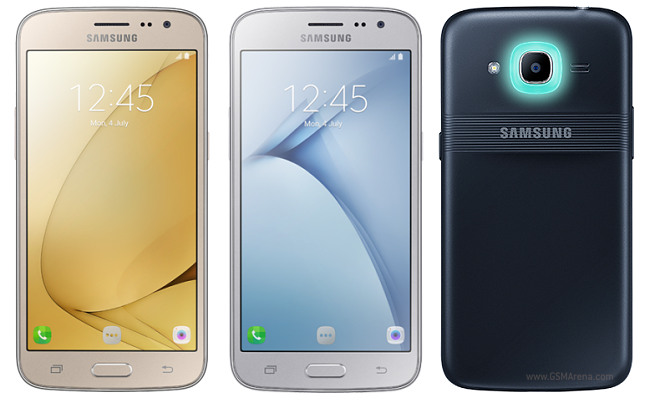
Samsung galaxy J1 (2016) review
Versions: J120F (Global); Galaxy Express 3
J120A (AT&T); J120H, J120M, J120M, J120T
Also known as Samsung Galaxy J1 (2016) Duos
with dual-SIM card slots
NETWORK
LAUNCH Announced 2016, January
Status Available. Released 2016, January
BODY Dimensions 132.6 x 69.3 x 8.9 mm (5.22 x 2.73 x 0.35 in)
Weight 131 g (4.62 oz)
SIM Single SIM (Micro-SIM) or Dual SIM (Micro-SIM,
dual stand-by)
DISPLAY Type Super AMOLED capacitive touchscreen, 16M
colors
Size 4.5 inches (~44.8% screen-to-body ratio)
Resolution 480 x 800 pixels (~245 ppi pixel density)
Multitouch Yes
PLATFORM OS Android OS, v5.1.1 (Lollipop)
Chipset Spreadtrum SC9830
CPU Quad-core 1.3 GHz Cortex-A7
GPU Mali-400
MEMORY Card slot microSD, up to 256 GB (dedicated slot)
Internal 8 GB, 1 GB RAM
CAMERA Primary 5 MP, f/2.2, autofocus, LED flash
Features Geo-tagging, touch focus, face detection
Video 720p@30fps
Secondary 2 MP, f/2.2
SOUND Alert types Vibration; MP3, WAV ringtones
Loudspeaker Yes
3.5mm jack Yes
COMMS WLAN Wi-Fi 802.11 b/g/n, Wi-Fi Direct, hotspot
Bluetooth v4.1, A2DP, LE
GPS Yes, with A-GPS, GLONASS
Radio FM radio, RDS, recording
USB microUSB v2.0
FEATURES Sensors Accelerometer, proximity
Messaging SMS(threaded view), MMS, Email, Push Mail, IM
Browser HTML
Java No
- MP4/H.264 player
- MP3/WAV/eAAC+/Flac player
- Photo/video editor
- Document viewer
BATTERY Removable Li-Ion 2050 mAh battery
Talk time Up to 12 h (3G)
Music play Up to 39 h
MISC Colors White, Black, Gold
SAR US 1.58 W/kg (head) 1.18 W/kg (body)
SAR EU 0.70 W/kg (head) 0.59 W/kg (body).
